The damaged hip joint is replaced with an artificial one. It is used for severe arthritis or bone death (osteonecrosis) when other treatment has not helped, and for some broken hips.
Fall or suspected broken bone? Go to the nearest emergency department now, or call Rescue 1122, if the person cannot stand or put weight on the leg, a limb looks bent or a bone is showing, a hand or foot is cold, pale or numb, there is heavy bleeding, or they hit their head. An older person who cannot walk after a fall may have a broken hip and needs to go to hospital now. Do not move someone who may have hurt their neck or back.
Once the patient is safe, call +92 300 4890692 for fracture care with Dr Malik. Dr Malik can arrange care in the emergency department: WhatsApp the X-ray, the patient’s medical history and any medical conditions to the same number. If you cannot reach us, go to the nearest emergency department.
How is the operation done?
It is done under anesthesia: either spinal (numb from the waist down) or general (fully asleep).
- 1. The cut: a cut is made at the side, back or front of the hip, and the muscles are gently moved aside.
- 2. Removing the damaged ball: the worn ball of the hip joint (femoral head) is removed.
- 3. Fitting the stem: a metal stem goes into the thigh bone. It is held with bone cement, or fitted tightly so the bone grows onto it (press-fit). A new ceramic or metal ball is fixed to it.
- 4. Preparing the socket: the socket (acetabulum) is shaped and a new cup is fitted. This is either a metal cup pressed into the bone (sometimes held with screws), or a plastic cup held with bone cement.
- 5. Adding the liner: if a metal cup is used, a smooth plastic or ceramic liner goes inside it, so the new ball moves easily.
- 6. Closing the wound: the wound is closed with stitches or staples.
Different ways to reach the hip
- From the side or the back (lateral or posterior approach): the traditional methods.
- From the front (anterior approach): the surgeon works between the muscles instead of cutting them, which may mean less early pain.
Smaller-cut (minimally invasive) surgery can mean less blood loss and getting up a little sooner for suitable patients. Long-term results are similar, but it is not right for everyone.
Dr Malik will explain which approach suits you at your consultation.
How long does a new hip last?
Usually many years. In large joint registries, about 9 in 10 total hip replacements are still working after 15 years, and nearly 6 in 10 after 25 years.
Recovery: what to expect
Dr Malik will tell you how long you are likely to stay in hospital.
- Walking: you start walking with a walker or crutches on day 1 or 2.
- Physiotherapy: starts in hospital and continues at home or in a clinic. Most patients move from a walker to a stick within a few weeks.
- Pain relief: medicines, and sometimes a nerve block (an injection that numbs the area).
- Watching for problems: the team checks for infection, blood clots and dislocation (the ball slipping out of the socket). These are uncommon. You may be given blood-thinning medicine to take at home for some weeks. Take it exactly as prescribed. Warning signs to watch for at home are listed below.
After you go home, the wound is usually checked and stitches or staples removed at about 10 to 14 days. Check-ups are then often at about 6 weeks, 3 months and 1 year, with an X-ray to check the new hip. Questions between visits? WhatsApp +92 300 4890692.
Recovery at home, week by week
- Weeks 1–2: a walker or crutches, and your exercises every day.
- Weeks 3–6: many people move to a walking stick.
- Work: office work often after about 4 weeks. Ask Dr Malik first.
- Driving: usually after about 8 weeks, and only when Dr Malik agrees. It may take longer after a right hip operation.
- Tobacco: stop smoking and all tobacco, including naswar and chewing tobacco. It slows bone and wound healing.
Protect the new hip in the early weeks: do not cross your legs, squat or sit on the floor. Use a raised toilet seat or commode, and pray on a chair. Sleep on your back or side with a pillow between your legs. Dr Malik will tell you if and when it is safe to sit on the floor or squat again.
When to get help after a hip replacement
- The wound is red, hot, swollen or leaking, or you have a fever: call +92 300 4890692 the same day.
- Calf pain or swelling, or a warm, red leg: call the same day.
- If you cannot reach the clinic, go to the nearest emergency department.
- Chest pain or sudden breathlessness: go to the nearest emergency department now or call Rescue 1122.
- Sudden severe hip pain, a leg that looks shorter or turned, or you cannot stand on it: the hip may have dislocated. Do not try to push the hip back. Go to the nearest emergency department now or call Rescue 1122.
Is it safe for an older parent?
Age alone does not decide. General health is checked first, including the heart, blood pressure and blood sugar. All surgery has risks. The main ones are:
- infection
- blood clots
- dislocation (the ball slipping out of the socket)
- nerve or blood-vessel injury
- legs of slightly different length
- pain that does not settle
- the new hip wearing or loosening over time, which may need another operation
Dr Malik goes through these with you and your family, then you decide together.
How well does it work?
For most patients, a hip replacement greatly eases pain and makes walking easier. Complications are uncommon.
Hip replacement with Dr Malik in Lahore
Dr Malik is an orthopedic and trauma surgeon in Lahore. He has more than 20 years of experience in orthopedic surgery. He performs every operation himself.
Sources
Evans JT and others. How long does a hip replacement last? The Lancet, 2019 (data from national joint registries in several countries).
Questions families ask
How much does it cost?
The consultation fee depends on the hospital you visit. We tell you the exact fee on WhatsApp before you book, so there are no surprises. A follow-up visit within 5 days of your first consultation is free to go through your reports and scans.
The cost of surgery depends on the operation, the implant, the room and the nights in hospital. It is explained to you before you decide.
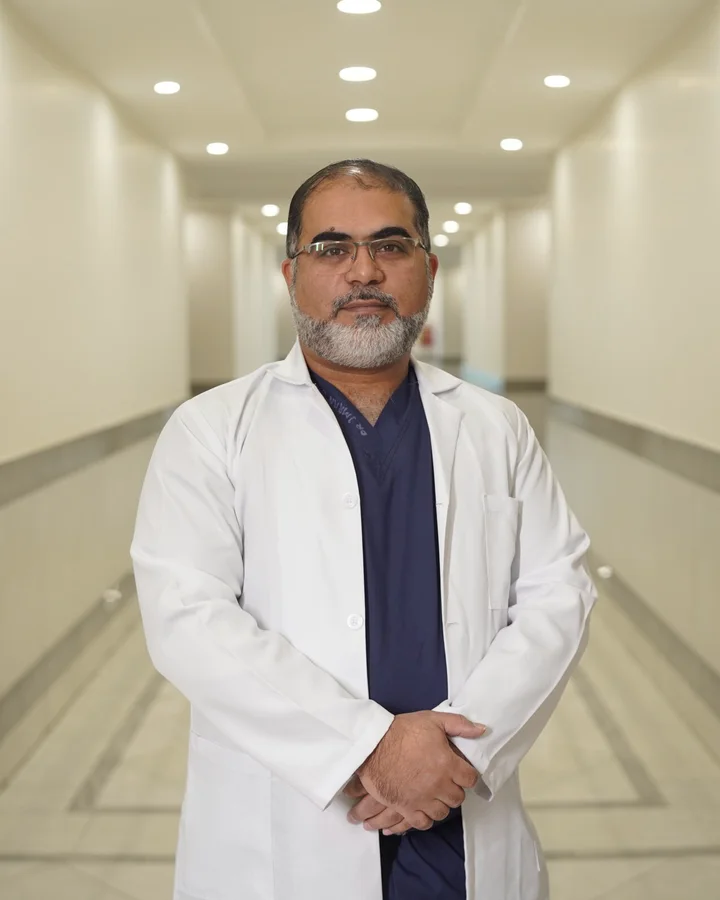
From the clinics of Dr Imran Salim Malik, orthopaedic and trauma surgeon. MBBS (Allama Iqbal Medical College) · MS (Trauma & Orthopaedics) · PMDC Reg. 39646-P. Every patient is different: Dr Malik will tell you what applies to you.